This project was conducted in collaboration with Simon Rigoulot, Melissa Kadi and Simone Dalla Bella at the International Laboratory for Brain, Music and Sound Research (BRAMS) in Montreal, Canada.
We investigated EEG responses to auditory oddball sequences that had an isochronous or random inter-stimulus interval (ISI), while comparing younger with older adults.
We found that the P50 distinguishes between isochrounous and random standard tones in the younger adult group, but not in the older one.
Sonja will be a speaker in a virtual “Tinnitus mini-symposium” on July 8 (16-18h CEST). The other speakers are Prof. Holger Schulze on “Neurophysiological Mechanisms of Tinnitus Development” and Dr. Minke van de Berge on “Tinnitus and Auditory Brainstem Stimulation”. The scientific symposium will take place online and is organised in collaboration with Maastricht University, Zuyderland and MUMC+. The targeted audience are audiologists, ENT specialists, researchers, psychologists and other professionals interested in tinnitus.
Sonja was recently interviewed (in German) as part of a series “Kunst trifft Wissenschaft”, where she talked about the human sense of rhythm: why it affects our perception and action and influences cognitive processes.
Our new paper discusses the role of the medial geniculate nucleus (MGB) in tinnitus, while reflecting on animal and human studies. Tinnitus is prevalent in 10-15% in the general population and its underlying mechanism still remains elusive. Here we propose a more general aproach of adaptive sensory gating and temporal processing along the auditory pathway that might add to the thalamo-cortical dysrhythmia profile of tinnitus.
How does our brain process vocal emotions: in categories or dimensions? When we hear an emotionally charged voice, does our brain analyse the emotion as a separate category or as continuous dimensions? An international team of researchers has come up with a surprising answer to this question using a combination of neuroimaging techniques and computational models of the voice: it’s not one or the other, but both. Voice emotions are initially processed by the brain as separate categories, before being refined into dimensions.
We all know how effective the voice is at conveying emotions. What we know less about is whether our brain treats vocal emotions as separate categories (such as pleasure or fear) or along a continuum of emotional dimensions (such as negative to positive). A new study puts an end to this long-standing debate by showing that it is neither categories nor dimensions, but both, with quite different brain dynamics.
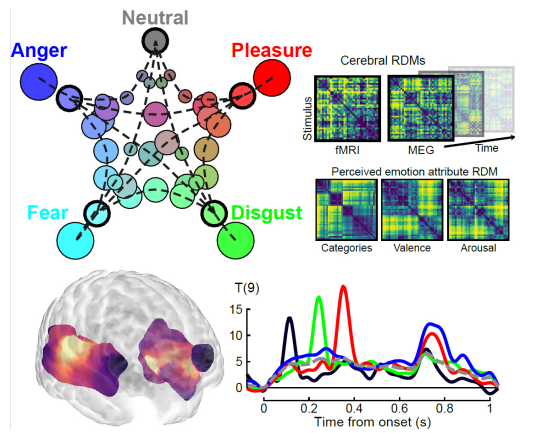
An international consortium of researchers from France, Scotland, Germany, Holland, Canada, and the United States used brain imaging to measure the brain activity of healthy adult volunteers as they listened to brief affective vocalizations representing different emotions. The affective properties of the vocalizations were controlled using a computational model to produce a wide range of more or less intense and identifiable emotions. The participants each underwent several sessions of functional magnetic resonance imaging and magnetoencephalography to maximize the spatial and temporal resolutions of the brain activity measurement as well as statistical power. Sophisticated analyses indicate that both categories and dimensions explain much of the brain’s activity, but differently: while early brain activity within 2/10ths of a second reflects distinct emotional categories, later neural responses (after half a second) are increasingly consistent with a finer, graduated representation of emotional dimensions.
These new data make it possible to reconcile two long opposing views by describing with a high degree of spatio-temporal detail the representational dynamics of the cerebral processing of emotions in the voice.
This study was supported by funding from the British BBSRC and the French ANR; the manuscript and data are freely available.
Analysis of cerebral representations of vocal emotion. Top left: brief affective vocal expressions are generated by morphing between recordings corresponding to 4 emotions (anger, fear, disgust, pleasure) and a neutral expression. Top right: matrices representing the differences in brain activity between each pair of stimuli, each brain region and each millisecond are compared to matrices based on emotional judgments reflecting either categories or emotional dimensions. Bottom: representation of brain regions showing an association with emotional categories at an early stage.
Original publication: Giordano, B.L., Whiting, C., Kriegeskorte, N., Kotz, S.A., Gross, J., Belin, P. The Representational Dynamics of Perceived Voice Emotions Evolve from Categories to Dimensions, accepted for publication in Nature Human Behaviour.
Interested in Rehabilitation Sciences? There is a PhD vacature in the REVAL Rehabilitation Research group, on auditory-motor coupling in MS, in the context of an FWO granted project. This PhD is situated within an interdisciplinary project, combining disciplines of rehabilitation sciences (UHassetl), musicology (UGent), and neurosciences (UMaastricht).
Interested candidates should have a background in rehabilitation sciences, movement sciences, cognitive sciences or neurosciences with a keen interest in clinical testing and learning neurophysiological EEG methods.
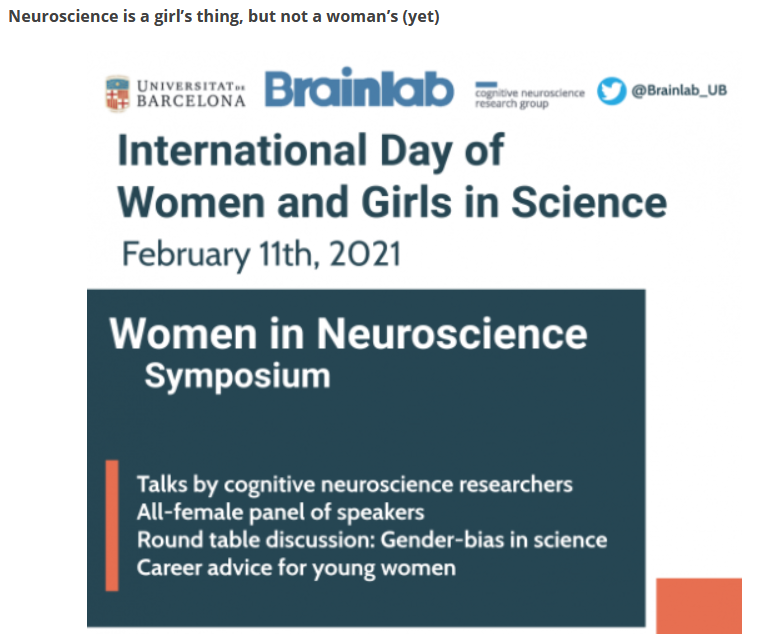
Our lab director Sonja Kotz will give a keynote talk with the title “Cortico-subcortico-cortical circuitry and the timing of sensorimotor behaviour”at the Women in Neuroscience Symposium on Feb 11, 2021. This great initiative has been organized by PhD students of the Brainlab and registration is free. Here you can find more information about the symposium and the speakers. Here is the program and here is the link to register.







 BAND Lab